
Spinal Surgery
Mr McGillion offers a comprehensive range of spinal surgical procedures for patients with degenerative, traumatic and deformity-related conditions of the cervical and lumbar spine. Surgery is only recommended where appropriate, typically when non-operative treatments have not provided sufficient relief or where there is progressive neurological compromise. Following careful assessment and detailed discussion, the most suitable surgical option can be tailored to the individual patient’s condition and goals.
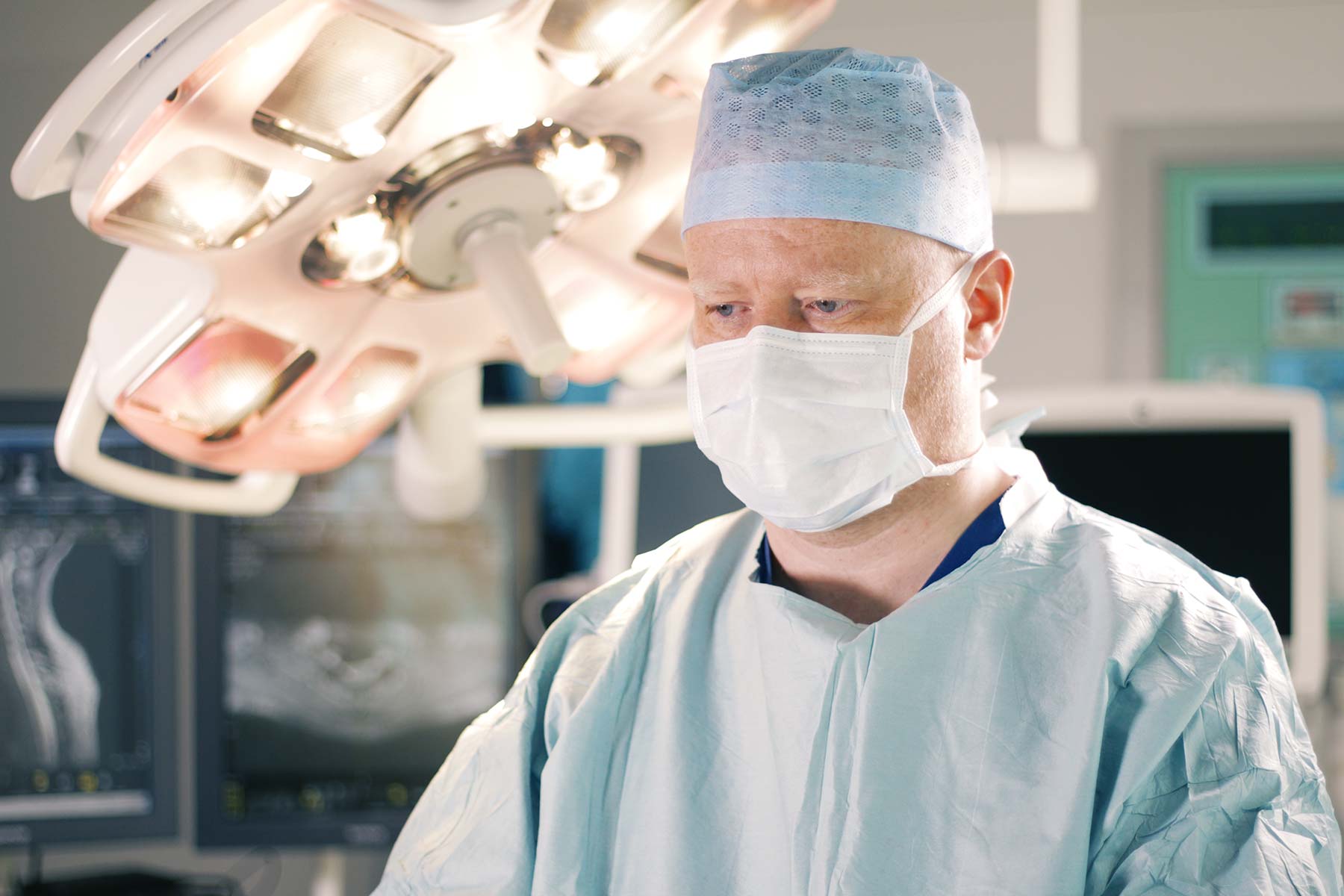
Minimally Invasive Spinal Surgery
Minimally invasive spinal surgery uses specialised instruments and imaging techniques to access the spine through smaller incisions than traditional open surgery. By reducing muscle disruption, this approach may result in less postoperative pain, reduced blood loss and faster recovery in suitable patients. Procedures such as decompression and spinal fixation can often be performed using minimally invasive techniques where clinically appropriate.
Lumbar Discectomy
A lumbar discectomy is performed to relieve pressure on a spinal nerve caused by a prolapsed or herniated disc. This condition commonly results in sciatica, with pain radiating down the leg. The procedure involves removing the portion of disc that is compressing the nerve, with the aim of relieving leg pain and improving function.
Correction of Scoliosis
Scoliosis refers to an abnormal curvature of the spine that may progress over time and, in some cases, cause pain or imbalance. Surgical correction involves carefully realigning the spine and stabilising it using rods and screws. This complex procedure is typically reserved for patients with significant deformity, progressive curvature or debilitating symptoms.
Anterior Cervical Discectomy and Fusion (ACDF)
Anterior cervical discectomy and fusion is a commonly performed operation for cervical disc herniation or degenerative changes causing nerve root or spinal cord compression. The affected disc is removed through a small incision at the front of the neck, relieving pressure on the nerves or spinal cord. The segment is then stabilised using a bone graft or implant to promote fusion.
Laminectomy
A laminectomy involves removing part of the vertebral bone (the lamina) to create more space for the spinal cord or nerve roots. It is most commonly performed for spinal stenosis, where narrowing of the spinal canal causes leg pain, numbness or weakness. The aim is to decompress the neural structures and improve symptoms.
Cervical Spine Surgery
Cervical spine surgery encompasses a range of procedures performed to treat conditions affecting the neck, including disc herniation, spinal stenosis, myelopathy and degenerative disease. Depending on the underlying condition, surgery may involve decompression of the spinal cord or nerve roots, fusion of affected segments, or motion-preserving techniques such as cervical disc replacement.
Spinal Surgery
Mr McGillion is happy to assess your condition and discuss in detail what treatment options are available so you are in a position to make an informed decision about your subsequent care. Further information on scoliosis and kyphosis is available from the British Scoliosis Society and Scoliosis Association UK websites.